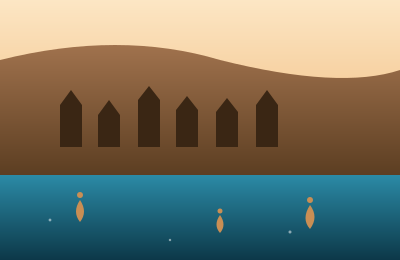
Demre · Myra · Kekova — St. Nicholas & the Sunken City
Lycian rock tombs, the original Santa Claus and a glass-bottom boat over a sunken Roman village
Overview
The original 4th-century church of St. Nicholas of Myra, the Lycian rock-cut tombs above it, and a boat ride over Kekova's sunken Roman village where you can still see the walls and amphorae through the water.
What to Expect
Three Acts of Lycian History in a Single Day
Few day trips on the Turkish coast pack as much into a short stretch of shoreline as Demre and Kekova. In one route you walk through the Byzantine church that holds the tomb of the real Saint Nicholas, stand beneath house-shaped tombs carved straight into a cliff by a people who vanished two thousand years ago, then glide in a boat over the drowned walls and staircases of a Lycian town an earthquake pushed under the sea. It is history you can read in three layers — Lycian, Roman, Byzantine — all within a few kilometres of the modern town of Demre, in the Kas district of Antalya province. Most visitors leave surprised by how much they did not know.
Who Saint Nicholas Really Was
The man behind Santa Claus was a flesh-and-blood bishop. Nicholas was born around 270 in nearby Patara and became bishop of Myra, the Lycian city beneath modern Demre, dying around 343. He was imprisoned during the persecutions of Emperor Diocletian and freed when Constantine legalised Christianity. Stories of his secret gift-giving and protection of children and sailors spread across Europe, and Dutch and German traditions slowly reshaped his name into Santa Claus. The church you visit was built in the 6th century over an earlier shrine where he was buried. In 1087 Italian merchants from Bari carried off most of his relics, which is why the tomb here stands empty of its famous occupant.
Inside the Church of St Nicholas
The church sits about a metre below today's street level — centuries of silt from the Demre stream gradually buried it, which ironically helped preserve it. After an 18-month government restoration it reopened in May 2023 with a protective roof over the whole structure, conserved wall frescoes and re-laid floor mosaics. Inside you see Byzantine fresco fragments of saints, intricate opus sectile marble paving, and the carved limestone sarcophagus long associated with Nicholas, tucked in a side chapel. Excavations continue: in December 2024 archaeologists uncovered a second sarcophagus buried beneath the mosaic floor in an annex, and dating work is ongoing to test whether it marks his original grave.
Myra: Rock Tombs and the Largest Theatre in Lycia
A short drive from the church, the ruins of ancient Myra deliver the trip's most cinematic moment. Two cliff faces are honeycombed with Lycian rock-cut tombs carved as miniature houses — complete with carved beams, doors and windows — because the Lycians built their tombs to mirror their wooden homes, believing the dead travelled to the afterlife. The famous Lion Tomb still shows reliefs of a family. Beside them stands the best-preserved Roman theatre in Lycia, seating roughly 11,000; it was wrecked by an earthquake in AD 141 and rebuilt. You can wander the vaulted passages and climb the seating, with the tombs glowing overhead in afternoon light.
- Two necropolises: the dramatic "river" cliff face by the theatre and a second "sea" group nearby
- Tomb facades imitate Lycian timber houses — look for carved roof beams and window frames
- Theatre stage building is littered with carved masks and reliefs worth a slow look
- Allow at least 60-90 minutes here; the seating climb rewards you with the full tomb panorama
- Myra existed by at least the 5th century BC and was one of Lycia's six leading cities
Kekova and the Sunken City of Simena
The boat leg is the part people remember most. In the 2nd century AD a powerful earthquake dropped the southern shore of the island then called Dolichiste below the waterline, submerging a Lycian settlement. Today, from the deck of a boat, you look down through extraordinarily clear turquoise water at staircases that descend into nothing, foundation walls, doorways and broken jars resting on the seabed. Boats slow and often pause over the best sections. Swimming and diving directly over the ruins are banned to protect them, so the site is appreciated from above — many boats have viewing panels in the hull to sharpen the view in calm conditions.
Kalekoy (Simena) and Its Castle
Most trips moor at Kaleköy, the tiny car-free village built on ancient Simena, reachable only by boat or footpath. A steep lane climbs past gardens where Lycian sarcophagi lean among the flowers to a medieval castle crowning the hill. From its walls you get a sweeping view over Kekova island and the bays, and inside sits the smallest ancient theatre in Lycia, cut into the rock for just a few hundred spectators. Boats also stop to swim and snorkel in sheltered coves such as Aquarium Bay and Tersane Bay, where a half-submerged Byzantine apse stands at the water's edge.
A Realistic Flow of the Day
A comfortable full-day rhythm starts early to beat the heat and the coach crowds. Distances are short — Kas to Demre is around 40 minutes, and the boat departure points at Üçağız or Demre harbour are only 20-30 minutes apart by road. A typical day looks like this, though a private driver can reorder it to dodge the busiest moments at each stop.
- Morning: Church of St Nicholas at opening, before tour buses arrive
- Mid-morning: ancient Myra — rock tombs and the Roman theatre
- Around midday: transfer to Üçağız harbour and board the Kekova boat
- Early afternoon: glide over the sunken city, then moor at Kaleköy for the castle climb
- Afternoon: swim and snorkel stop in a quiet bay; lunch on board or in the village
- Late afternoon: return to harbour and a relaxed drive back
Best Time to Go
May, June, September and October are the sweet spots: warm, sunny days, sea still pleasant for swimming, and far thinner crowds than the July-August peak when midday heat and tour traffic both spike. Spring brings wildflowers across the Lycian hillsides and the coolest conditions for clambering around the ruins. The Kekova water is clearest and the sunken city most visible on calm, bright days, so a settled-weather forecast matters more than the exact month. Winter is best avoided: it is cooler and wetter, some boat services pause, and the light is poor for seeing the underwater ruins.
What to Bring and Who It Suits
This is an easy trip for most people, but the day mixes ruins, a steep village climb and time on the water, so plan for all three. Couples love the boat and the photogenic tombs; families do well because kids are genuinely gripped by a real sunken city and a Santa connection they can stand inside. Be realistic about mobility: Myra's theatre seating and the Simena castle path involve uneven stone and steps, though the church and the boat itself are largely accessible.
- Sun protection: hat, sunglasses, high-SPF cream — there is little shade on the boat or at Myra
- Swimwear and a towel for the bay stop; water shoes help on rocky entries
- Sturdy, grippy shoes for the theatre and the Simena castle climb
- Shoulders and knees covered for the church out of respect, even though it is a museum
- Cash in Turkish lira for village cafes, the castle, and the church entrance
- Water and a light layer; the breeze on the water can feel cool even on hot days
Why a Private Door-to-Door Tour Works Better Here
This route punishes rigid schedules. On a 40-seat coach you arrive at the church and Myra in the busiest window, wait for the slowest passenger at every stop, and reach the boat when dozens of others do. With a private Mercedes and a driver-guide, you set off early to hit the church empty, linger at the tombs when the light is best, and join the boat at a quieter moment. Door-to-door pickup from your hotel removes the dawn meeting-point shuffle, and you can pause for a coffee, a viewpoint or a longer swim without negotiating with a busload. The history is the same; the day is calmer and yours.
Demre · Myra · Kekova — St. Nicholas & the Sunken City
The original 4th-century church of St. Nicholas of Myra, the Lycian rock-cut tombs above it, and a boat ride over Kekova's sunken Roman village where you can still see the walls and amphorae through the water.
Included in the price
- Mercedes V-Class with English/German-speaking driver-guide
- Entrance to St. Nicholas Basilica + Myra archaeological zone
- Private glass-bottom boat charter (not a shared tourist boat)
- Bottled water and shaded rest stops
- Hotel pickup & drop-off
What you'll do
- 08:00 pickup — 2 hour scenic drive west along the Lycian coast
- Demre — the genuine 4th-c. Byzantine church of St. Nicholas
- Myra rock-cut tombs and the Roman theatre directly below them
- 90 min glass-bottom boat over the sunken Roman village of Kekova
- Lunch in Üçağız fishing village (sea-caught calamari, not in the price)
- Çayağzı Castle stop for harbour views — back by 19:00
Why book this tour with SooTransfer
Coach tours stop at Kekova on a 50-person yacht with 10 minutes over the ruins. We book a private 6-person glass-bottom skiff that can hover where the amphorae lie, and we time the visit for slack tide when the water is clear.
Booking & cancellation
- Reservation: Quote within 5 minutes via the website form or WhatsApp.
- Payment: Cash on tour day (EUR / USD / GBP / TRY), credit card or bank transfer.
- Free cancellation: Up to 24 h before pickup — full refund, no questions.
- Group discount: 8+ guests get 10% off automatically.
- Custom routing: Available — message us with your dream day.
- Languages: Driver-guides speak English, Turkish, German and Russian — tell us your preference.
📖 Frequently Asked Questions
Is swimming allowed at Kekova?
Swimming directly over the ruins is forbidden by UNESCO rules, but the boat anchors at a permitted swim cove afterwards. Bring a swimsuit.
How religious is the St. Nicholas visit?
It's a historical site — services run only on December 6th. Year-round you can visit the original tomb and the mosaics, no religious commitment.
Plan your trip
Arriving for this tour? Book your private airport transfer and explore the area:
Other tours you may like

Pamukkale & Hierapolis — Travertine Day
White terraces, Cleopatra's pool and a Roman ghost city

Perge · Aspendos · Side — The Roman Trilogy
Three of Turkey's best-preserved Roman cities in one quiet day

Phaselis · Olympos · Chimera — Sunset & Eternal Flames
Lycian harbour ruins, sea-turtle beaches and flames that have burned for 2000 years

Ephesus & Şirince Village — Roman City & Aegean Vines
The library of Celsus and a wine-tasting in a Greek-Ottoman hill village
Why this guide is trustworthy
People also booked
Last updated Reviewed by Verified operatorPublished by SooTransfer editorial